How Step Builds Credit (The Actual Mechanism) ⚙️

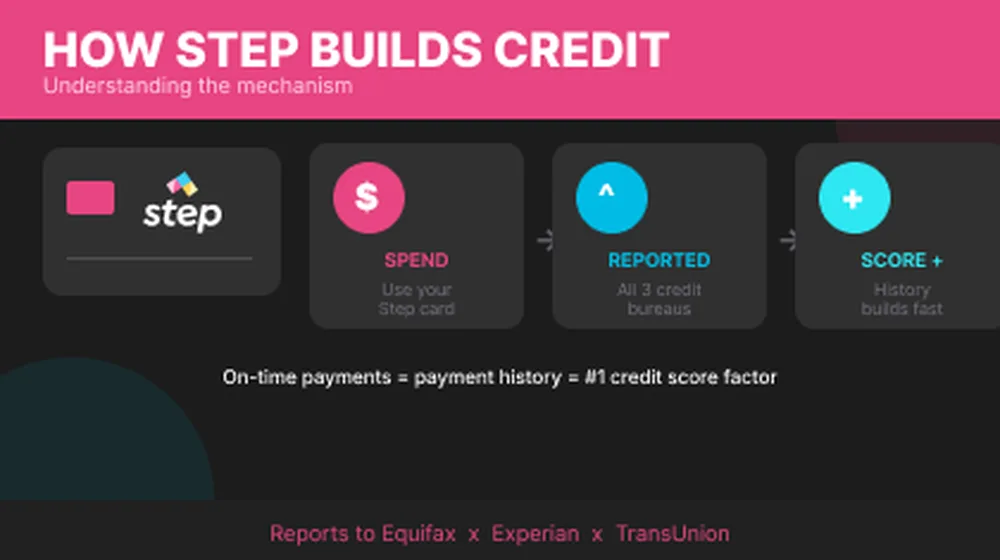
There's a big difference between a product that helps you manage money and one that actually builds your credit file. The distinction comes down to one thing: bureau reporting. If your spending isn't showing up at TransUnion, Equifax, and Experian, lenders can't see it, and it doesn't count toward your score.
Step is built around this from the ground up. Every purchase on the Step Visa Card gets reported to all three major credit bureaus as an on-time payment. That's the whole mechanism, and it's what separates using Step from using a regular prepaid card or bank account that never touches your credit file.
How it actually works
When you fund your Step account, that balance becomes your spending power on the Step Visa Card. It's a secured credit card, which means your spending is backed by the funds you've deposited. When you swipe or tap the card at a store or online, you're spending that balance. At the end of the billing cycle, Step reports the payment to all three bureaus: payment received on time.
Month two, the same thing. Month 12, you've got 12 months of on-time payment reports stacked in your credit file. Month 36, you've got three full years. That's your credit history, compounding with every passing month.
The mechanism is simple because credit scoring is simpler than most people think. Payment history is 35% of your FICO score. Every on-time payment you make is a data point in your favor. The more you have, and the longer the streak, the stronger your credit profile gets. Step's job is to make sure every purchase you make counts as one of those data points.
The reporting side explained
Credit scores are built from data that your creditors report to the bureaus. When a lender pulls your score, they're looking at everything those bureaus have on file. If your payment history isn't being reported there, it simply doesn't exist in your credit profile, regardless of how reliably you pay.
Step's reporting is clean and consistent. Every month, without you doing anything special, the system transmits account activity to all three bureaus: account open, payment received on time. The data is accurate and timely, which is exactly what you want showing up in your credit file. No gaps. No delays. Just reliable month-to-month reporting that builds your history deeper every billing cycle.
Why Smart Pay is a game changer
Late payments are the single fastest way to hurt a credit score. One missed payment can undo months of progress and stick to your credit file for years. The problem is that life gets busy, and billing cycles don't care about your schedule. Step's Smart Pay is Step's autopay feature, and it removes this risk entirely. You set it up once, link your bank account, and Smart Pay pays your full balance every month automatically. You never forget. You never slip. The consistency that builds the 57-point average is, in large part, a direct result of users who set this up and never miss a payment cycle.*
What Step gives you beyond credit building
Because Step is a full banking app, not just a credit tool, using it comes with real financial benefits alongside the credit reporting.
FDIC insurance on your funds, so your balance is protected up to applicable limits
A Visa Card accepted everywhere Visa is, online and in stores
Real-time spending visibility through the Step app
No minimum balance requirements on the standard plan
3% on your savings ~supsymU+033E which is one of the best rates in the nation ~supsymU+033E ~supsymU+033E
Unlimited cashback on purchases with Step Black ~supsymU+02D6 ~supsymU+02D6
The Step Visa Card is a secured credit card with a real banking platform behind it. You're not just building credit; you're managing your money in the same place. That's the combination that makes it practical to actually use every day, which matters because consistent use is what generates the payment history your credit file needs.
What the first year looks like
At the end of month one, you've got your first payment record. That's the start of your credit file. Month three, three months of history. Month six, half a year. Month 12, you've got a full year of on-time payments compounding into your score. Step users in their 20s average a 57-point increase in their first year of consistent use. ~supsymU+0346 That reflects the combined effect of a growing payment history, manageable utilization, and an account that's been aging for 12 months. Results vary based on your starting score, how often you use the card, and your broader credit situation, but the mechanism behind that number is straightforward and trackable.*
The average isn't a ceiling either. Some users see more. Some see results in fewer months. What stays constant is the underlying driver: every month you're on Step and using the card is a month of clean credit data working in your favor.
Start building right now
Fund your Step account. Activate your Step Visa Card and start using it for everyday spending. That's the whole process.
You're not doing anything complicated. You're using a card for purchases you'd make anyway, and the credit building happens as a built-in side effect of how Step reports to the bureaus. Every month you wait is a month of credit history you'll never get back. Use this credit building app and let the mechanism do its job.
You can even start before 18
One of the most unique features about Step, is you can start buidling your credit history before you turn 18. With Step, you can report up to two years of history when you turn 18. This means, all of your transactions from 16 on will be reported and you will have a two year headstart when you turn 18. In fact, Step users have an initial credit score of 721, ~supsymU+05A0 and people who start their credit journey with Step start over 125 points higher than the national average. ~supsymU+0595
Individual results may vary. Credit score changes depend on multiple factors including starting score, usage frequency, and your full credit profile. 57 points reflects the average first-year increase for Step users in their 20s and is not a guaranteed outcome.