How to Build Credit at 18 (Fast)
Start building your credit file the moment you turn 18. Here's exactly how the mechanism works and why starting now beats waiting.

Here's something most 18-year-olds don't know: the moment you turn 18, you have a real advantage over everyone who's older than you. Not in earnings, not in experience, but in credit. Time is the most powerful factor in your credit score, and right now, you've got more of it than you'll ever have again.
The catch? You actually have to use it.
Why 18 is the best age to start building credit
Your credit score is built on five things: payment history (35%), credit utilization (30%), length of history (15%), credit mix (10%), and new accounts (10%). Notice what carries the most weight. It's not your income. It's not your job. It's whether you've been paying on time and how long you've been doing it.
When you build credit at 18, your credit file opens now, while most of your peers haven't even thought about it. Five or six years from now, when everyone else is scrambling to catch up before a car loan or apartment application, your file is already full of history. That gap compounds into your 30s and beyond, and it's one of the most valuable financial advantages you can give yourself.
What actually builds credit (and what doesn't)
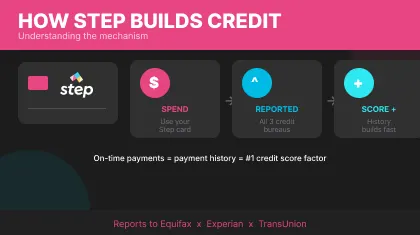
Not every card or app builds your credit. The key is finding a product that reports every payment to the three major credit bureaus: TransUnion, Equifax, and Experian. If it's not reporting to all three, it's not actually building your credit file where lenders can see it.
A secured credit card to build credit like the Step Visa Card does exactly that. Every purchase you make gets reported as an on-time payment to all three bureaus, starting from day one. There's no waiting period, no complicated application, and no existing credit history required. You fund your account, use the card for everyday purchases, and the reporting happens automatically.
This is why the Step Visa Card works so well for people starting out, or needing to improve their exisiting score: it's a secured credit card with real banking features built in. You use your own funds, spend normally, and the credit history builds as a side effect of purchases you would have made anyway. Many people rely on a debit card for these types of purchases, which doesn't offer any credit building benefit and will most likely charge you unwanted overdraft and maintenance fees.
The 57-point average and what it actually means
Step users in their 20s increase their credit score by an average of 57 points in their first year. ~supsymU+0346 That's not a promise or a ceiling. It's what tends to happen when on-time payment history stacks up month after month, starting from your very first transaction. Individual results will vary depending on your starting score, how often you use the card, and other factors in your credit profile.
Still, even understanding how and why credit scores move is a huge step. If you want a full breakdown, understanding credit scores makes it a lot clearer. The short version: consistent, on-time payments over time are what move the needle most.
How this actually works day-to-day
Once you fund your Step account and activate your Step Visa Card, the process is basically automatic. You swipe your card on everyday purchases like gas, groceries, or your streaming subscriptions. At the end of the billing cycle, the balance gets reported to the bureaus as a payment due. Smart Pay (Step's autopay feature) pays your full balance automatically. That payment gets logged as an on-time payment to all three bureaus.
The reason Smart Pay matters so much: missed payments are the single fastest way to tank a credit score. One missed payment can set you back months. Smart Pay removes that risk entirely, so there's no way to forget and no way to slip up.
What happens as you keep going
Month one, you've got your first payment on file. Month three, you've got a quarter of a year of history. Month 12, you have a full year of clean, on-time payments backing your score, and that's when you start seeing real movement.
Some people see results faster. Some see bigger jumps. It genuinely depends on your starting position and how actively you use the card. But the mechanism is locked in. Every single month you're on Step, your payment history gets stronger and your length of history grows.
This is why starting at 18 beats waiting until 25. You're not just building credit faster, you're building it longer. The seven years of payment history your peers won't have yet is what separates someone who gets approved for a mortgage at a good rate from someone who gets declined or hit with a brutal interest rate. To understand why this gap matters so much, read why building credit matters and avoid the common credit mistakes that slow people down.
Get started
Fund your account. Get your Step Visa Card. Use it for purchases you'd already be making. That's genuinely the whole move.
Your credit score is a function of time and consistent action. Right now, at 18, you've got more time than anyone. The sooner you start, the more of that time advantage you actually capture. The Step Visa Card is a secured credit card to build credit designed for exactly this. Fund your account in about 60 seconds and start building from day one.
Individual results may vary. Credit score changes depend on multiple factors including starting score, usage patterns, and full credit profile. 57 points reflects the average first-year increase for Step users in their 20s and is not a guaranteed outcome.