The 57-Point Effect: What a Year on Step Actually Does to Your Credit Score

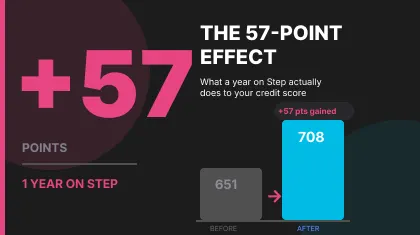
You've probably seen the stat: Step users in their 20s average a 57-point increase in their first year. ~supsymU+0346 It's a real number from real users, and it shows up consistently enough that it tells a genuine story about what happens when you pair a solid credit-building product with consistent, on-time payment behavior.
But 57 points is an average, not a promise. Some users see more. Some see results in fewer months. What you actually get depends on your starting score, how actively you use the card, and the rest of your credit profile. What's worth understanding is why the number moves and how to give yourself the best chance of being in that range or above it.
What 57 points actually does for you
Credit scores run from 300 to 850, but the score itself matters less than the bracket you're in. Here's how lenders generally see it:
Below 580 (poor): Hard to qualify for most credit products, car loans, and more
580 to 669 (fair): You might qualify, but rates are higher
670 to 739 (good): Normal approval on most products
740 to 799 (very good): Competitive rates across the board
800 to 850 (excellent): The best terms on everything
A 57-point increase doesn't mean the same thing to everyone. If you're starting at 600, hitting 657 keeps you in the fair range but puts you meaningfully higher in the band. Starting at 670 and reaching 727 moves you close to the very good range. Each bracket shift translates into real-world differences on loan approvals, interest rates, and what financial products you can actually access.
The practical impact of moving brackets compounds over time. Better rates on a car loan mean lower monthly payments. Better rates on an apartment application mean you actually get the place you want. The score is a proxy for financial access, and that access has dollar value attached to it.
Why the mechanism produces results
Understanding why credit scores move when you use Step makes it easier to use it well. The increase comes from three factors working together simultaneously.
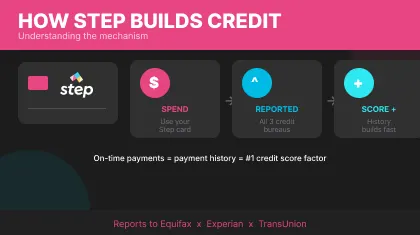
Payment history is 35% of your score. Every time you use your Step Visa Card and your billing cycle closes, Step reports an on-time payment to all three bureaus. One month of that is a start. Twelve months of that is a full year of clean payment history compounding into your score. The bureaus look at this as a pattern, and a consistent one builds trust.
Length of credit history is 15%. The moment you open your Step account, your credit history clock starts running. An account that's 12 months old carries more weight than one that's 3 months old. An account that's 36 months old carries even more. Time is doing work for you in the background just by having the account open.
Credit utilization is 30%. Because the Step Visa Card is a secured credit card and your spending is backed by your own funded balance, your utilization tends to stay manageable. You're not running up a balance you can't pay off. That keeps one of the biggest scoring factors working in your favor without much effort.
Those three factors together, operating consistently for 12 months, are where the 57-point average comes from.
The role Smart Pay plays
Smart Pay is Step's autopay feature, and it's your new best friend if you're serious about building credit. Here's why.
Late payments are the most damaging thing that can happen to a credit score. A single missed payment can offset months of positive history and stay on your report for years. Smart Pay removes that risk entirely by automatically paying your full balance every month from your linked bank account. You set it up once. The system handles it from there. You never forget. You never miss.
The consistency that produces strong credit growth isn't accidental. It's the direct result of never missing a billing cycle, and Smart Pay is the most reliable way to make that happen.
How to get the most out of your first year
Using Step isn't complicated, but a few habits make a meaningful difference.
Use the card regularly. More transactions mean more data for the bureaus about your spending and payment patterns. You don't need to overspend; just route your normal purchases through the Step Visa Card.
Move your auto pay subscriptions to your Step Visa Card. They will help you do the heavy lifting on a consistent basis.
Keep the account open. Your length of credit history starts decaying the moment you close an account. The Step Visa Card is an asset you want to keep aging, even if your spending patterns change.
Don't open too many new accounts at once. New accounts cause small, temporary score dips. Build your foundation with Step first, then add credit products later if you need a different credit mix.
The longer game
Fifty-seven points in year one is just the beginning. If you stay on Step and keep using the card consistently, the compounding accelerates over the following years. By year three, the bureaus are looking at three full years of payment data. That is real impact.
The credit score that feels distant at 18 becomes completely reachable, and that's years ahead of where peers who waited will be. That seven-year head start translates into access to better loan terms, lower interest rates on mortgages, and credit card offers that are actually worth having.
Starting early isn't just about the number. It's about being in a fundamentally different financial position by the time the big decisions come around.
Start now. Let it compound.
Fund your Step account. Get your Step Visa Card. Use the card for everyday spending. After that, you mostly just let the mechanism do its job.
One year from now, your credit file will be 12 months older. Twelve months of on-time payments will be stacked in your payment history. The score will reflect that.
Ready to get started? The Step Visa Card is a secured credit card to build credit that reports to all three major bureaus from your very first purchase. For a full breakdown of how credit scores work, check out understanding credit scores and use this credit building app to start building today.
Individual results may vary. Credit score changes depend on multiple factors including starting score, usage patterns, payment history, and your full credit profile. 57 points reflects the average first-year increase for Step users in their 20s and is not a guaranteed outcome. See step.com for full product details and current plan information.