What Is a Credit Score? (And How to Actually Improve Yours) 📊
Your credit score is a three-digit number with five specific inputs. Know the inputs, and you know exactly how to move the number.

You've heard that you need a good credit score. Maybe you've been told to "work on your credit" or "build your credit history." But if nobody's ever actually explained what a credit score is or how it moves, all of that advice is pretty useless. So let's break it down the real way.
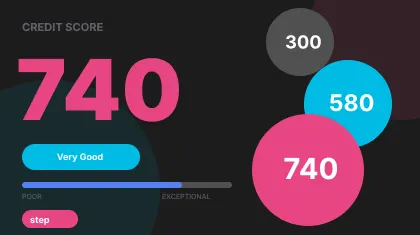
A credit score is a three-digit number, ranging from 300 to 850, that tells lenders how likely you are to pay back what you owe. The higher it is, the more financial doors open up for you. Lower interest rates on car loans. Easier apartment approvals. Better credit card terms. It's not arbitrary; it's a formula with five specific inputs, and once you know the inputs, you know exactly how to move the number.
The five factors and why they're not equal
Payment history accounts for 35% of your score. It's the single biggest lever. Have you paid your bills on time? Every on-time payment adds to your history, and that history compounds over time. One late payment costs you. Seven years of on-time payments builds real wealth inside your credit file.
Credit utilization is 30%. This is how much of your available credit you're actually using at any given time. Say you have a $500 credit limit and you're carrying a $450 balance. That's 90% utilization, and it's hurting your score. Drop the balance to $100 and you're at 20%, which actually helps. The general rule of thumb: keep utilization below 30% of whatever's available to you.
Length of credit history is 15%. This one is simple: how long has your credit file existed? A 10-year history beats a 2-year history every time. This is the long game, and it's exactly why starting to build credit at 18 is so valuable. Every year you're building is a year your peers aren't, and that gap compounds into your 30s and beyond.
Credit mix is 10%. Lenders like to see that you can handle different types of credit. A credit card shows you can manage revolving credit. A car loan or mortgage shows installment credit. Having both is ideal, but one type is completely fine when you're just starting out.
New accounts is 10%. Every time you open a new account, your score takes a small, temporary dip. Opening too many accounts in a short window looks risky to lenders. The move is to be strategic about it, not frantic.
What Step optimizes automatically
Here's the part that makes a credit building app like Step genuinely useful for this stage: it hits three of those five levers without you having to think about it.
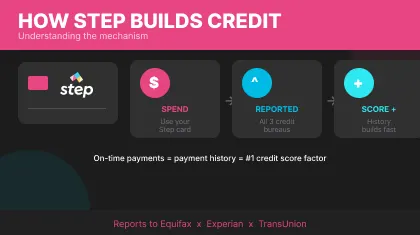
Every time you use your Step Visa Card, that purchase gets reported to TransUnion, Equifax, and Experian as an on-time payment. That's your payment history growing every single month. Your utilization stays manageable because you're spending from your own funded balance and paying it off automatically. And your length of history starts the moment you open your account, meaning it's compounding from day one.
Step users in their 20s average a 57-point increase in their first year. That's the result of those three levers working together consistently, month after month. Individual results will vary based on your starting score, usage patterns, and the rest of your credit profile, but the mechanism is real and it's trackable.
Why this matters at 18 specifically
Most people don't think seriously about credit until they actually need it, which usually means they're at 24, applying for a car loan, and realizing they have no history. Then they scramble.
An 18-year-old who starts building today has six full years of on-time payments stacked by the time they're 24. That's a completely different universe of financial access. And the compounding doesn't stop there. By 30, those same people are looking at mortgage applications, refinancing options, and investment products with credit scores that took their peers a decade longer to build.
What makes Step even more special and unique, is you can start building credit history prior to turning 18. Wtih Step, every purchase you make with your Step Visa Card will help you build credit history, and when you turn 18, Step will report up to two years of that history. This means, every purchase you use your Step Visa Card from when you turn 16 to when you start reporting your credit at 18 will build reportable history and help you get a headstart in the credit building game. In fact, Step users have an average initial credit score of 721! ~supsymU+05A0 That is 125 points above the national average, according to TransUnion. ~supsymU+0595
Lenders don't just look at your score in a vacuum. They look at the trajectory. Is it stable? Rising? An 18-year-old with years of clean payment history beats a 24-year-old with six months of history, practically every time, because the pattern tells a better story.
How to actually move the number
The practical path is straightforward. Start with one credit product that reports to all three bureaus. Use it regularly for everyday spending, things you'd buy anyway. Pay it off every month with Step's Smart Pay so you never miss a payment. Don't open a bunch of new accounts at once. Keep your utilization reasonable. Fund your Step account, activate your Step Visa Card, and see how Smart Pay will help handle the monthly bill automatically. Every month, the system reports: account open, payment received on time. Your payment history grows. Your account ages. Your length of history builds.
After 12 months, you've got a full year of clean data compounding into your score. If you want to go deeper on how the scoring works and what each factor actually means in practice, understanding credit scores lays it all out in plain terms.
Start where you are
You don't need a perfect financial situation to start building credit. You need one product, used consistently, with on-time payments. That's the whole game. Step users in their 20s increase their credit score by an average of 57 points in one year. ~supsymU+0346 Individual results depend on your starting score, usage patterns, and full credit profile. But the mechanism is real, it's been validated at scale, and it starts the moment you fund your account.
Open your account in 60 seconds. Step is a secured credit card to build credit that reports to all three major bureaus and comes with a real banking app. Fund your account. Use the Step Visa Card for everyday purchases. Every swipe builds credit, or credit history if you are under 18. That's the whole move.
Individual results may vary. Credit score changes depend on payment behavior, starting score, and full credit profile. Any credit-building outcome is not a guaranteed result.